
🚚 FREE U.S. Shipping on Orders Over $500
SKU: Cagril_5mg

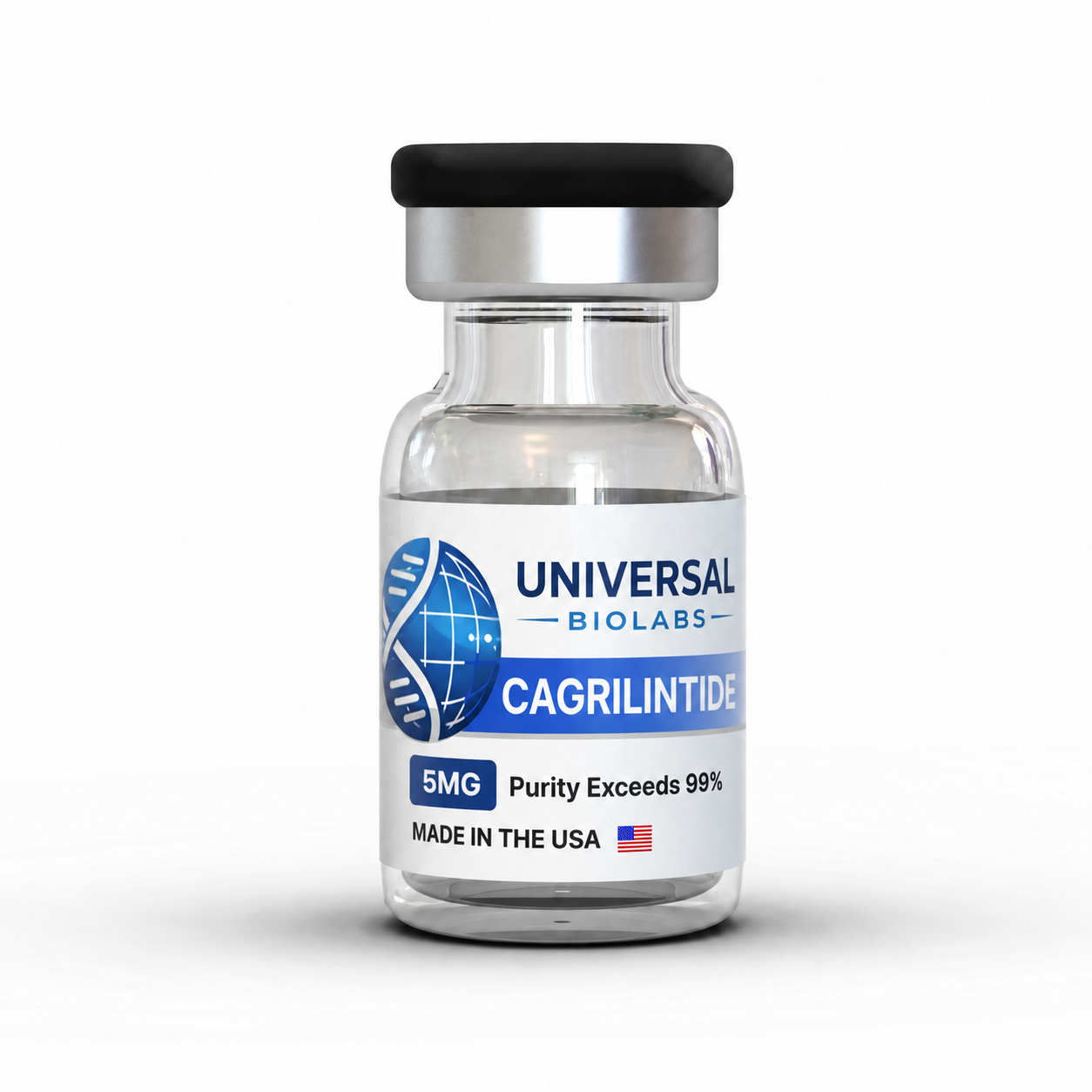
CAGRIL (5mg)

This compound is a synthetic 37-residue acylated amylin analogue. It carries a C20 diacid (eicosanedioic acid) side chain attached through a gamma-glutamate spacer, a C-terminal amide, and an intramolecular disulfide bridge. It is produced by solid-phase peptide synthesis and supplied as a lyophilized powder. The acyl side chain confers reversible albumin binding, and it is also referred to in the literature as AM833.

Its backbone derives from amylin, a 37-residue peptide, with substitutions selected during structure-activity work to reduce the fibrillation propensity that makes the native sequence difficult to handle in solution. Cagril is classified as a non-selective agonist of the calcitonin family of class B G protein-coupled receptors. This family includes the calcitonin receptor (CTR) on its own and the amylin receptors (AMY1, AMY2, AMY3), which are heterodimers of CTR with receptor activity-modifying proteins RAMP1, RAMP2, and RAMP3.

This material is supplied as a reference acylated agonist for non-clinical laboratory work, such as comparative binding, cAMP signaling, and structural studies of calcitonin family receptor complexes, and albumin-binding assays.

Chemical & Formula Details

  • CAS Number: 1415456-99-3
  • PubChem CID: 171397054
  • Molecular Formula: C₁₉₄H₃₁₂N₅₄O₅₉S₂
  • Molecular Weight: ~4409.1 g/mol


Storage & Handling
Store lyophilized powder at −20 °C, protected from light. Avoid moisture and repeated freeze-thaw cycles. Handle in accordance with standard laboratory safety practices.

FOR RESEARCH USE ONLY. Not for human consumption. Not intended for human or veterinary use. For laboratory research and analytical purposes only.

$89.99

Choose Quantity

Description

This compound is a synthetic 37-residue acylated amylin analogue. It carries a C20 diacid (eicosanedioic acid) side chain attached through a gamma-glutamate spacer, a C-terminal amide, and an intramolecular disulfide bridge. It is produced by solid-phase peptide synthesis and supplied as a lyophilized powder. The acyl side chain confers reversible albumin binding, and it is also referred to in the literature as AM833.

Its backbone derives from amylin, a 37-residue peptide, with substitutions selected during structure-activity work to reduce the fibrillation propensity that makes the native sequence difficult to handle in solution. Cagril is classified as a non-selective agonist of the calcitonin family of class B G protein-coupled receptors. This family includes the calcitonin receptor (CTR) on its own and the amylin receptors (AMY1, AMY2, AMY3), which are heterodimers of CTR with receptor activity-modifying proteins RAMP1, RAMP2, and RAMP3.

This material is supplied as a reference acylated agonist for non-clinical laboratory work, such as comparative binding, cAMP signaling, and structural studies of calcitonin family receptor complexes, and albumin-binding assays.

Chemical & Formula Details

  • CAS Number: 1415456-99-3
  • PubChem CID: 171397054
  • Molecular Formula: C₁₉₄H₃₁₂N₅₄O₅₉S₂
  • Molecular Weight: ~4409.1 g/mol


Storage & Handling
Store lyophilized powder at −20 °C, protected from light. Avoid moisture and repeated freeze-thaw cycles. Handle in accordance with standard laboratory safety practices.

FOR RESEARCH USE ONLY. Not for human consumption. Not intended for human or veterinary use. For laboratory research and analytical purposes only.

Additional information

Weight 0.1 lbs
Dimensions 1 × 1 × 2 in

Scientific Reviewer

Scientifically reviewed by Dr. Julian H. Park, MD. Dr. Park serves as Scientific Reviewer for Universal BioLabs, helping uphold the accuracy, credibility, and scientific rigor of all technical content and research citations. He earned his medical degree from the University of California, Irvine School of Medicine and completed residency training in family medicine at Cedars-Sinai Medical Center. With more than 20 years of clinical experience, Dr. Park reviews research citations, study interpretations, and technical content for scientific accuracy.

Disclaimer: For Research Purposes Only

This content is supplied exclusively for research and educational purposes. Nothing presented here should be interpreted as approval, promotion, or encouragement of any non-laboratory use, improper handling, or non-research application of peptides intended for scientific investigation. Any references to specific peptides, their properties, or findings associated with them are provided solely as informational research content. They are not medical advice, legal advice, clinical guidance, or a recommendation for personal, therapeutic, or non-research use. These compounds are intended only for controlled scientific work conducted by qualified and authorized individuals. Before making any decision regarding the purchase, possession, handling, or use of research peptides, appropriate consultation with qualified research professionals, medical experts, or legal counsel is strongly advised. All information should be used responsibly, ethically, and only in connection with legitimate academic, scientific, or investigative purposes. This notice applies broadly to all peptide-related content provided here and may be updated as needed.

0